
01 / MARKET & TARGETS
Customers & applications
The market concept spans home companionship, learning and play, care environments and service operations. Early validation focuses on people whose needs match Stage 1 conversation and expressive interaction.
Homes emphasize repeat use and convenience; educational settings require suitable content and controls; institutions need manageable operations and support. Each setting needs its own use cases.
02 / MARKET & TARGETS
Positioning
KER’s proposed position combines AI dialogue, expression and gestures with a platform that expands in stages. Validating emotional interaction before extending to mobility and assistance connects product development with market entry.
Competitiveness must be evaluated through response quality, willingness to keep using the product, maintainability and service costs in real settings. Competitor and market-size figures require source and date verification before publication.
03 / MARKET & TARGETS
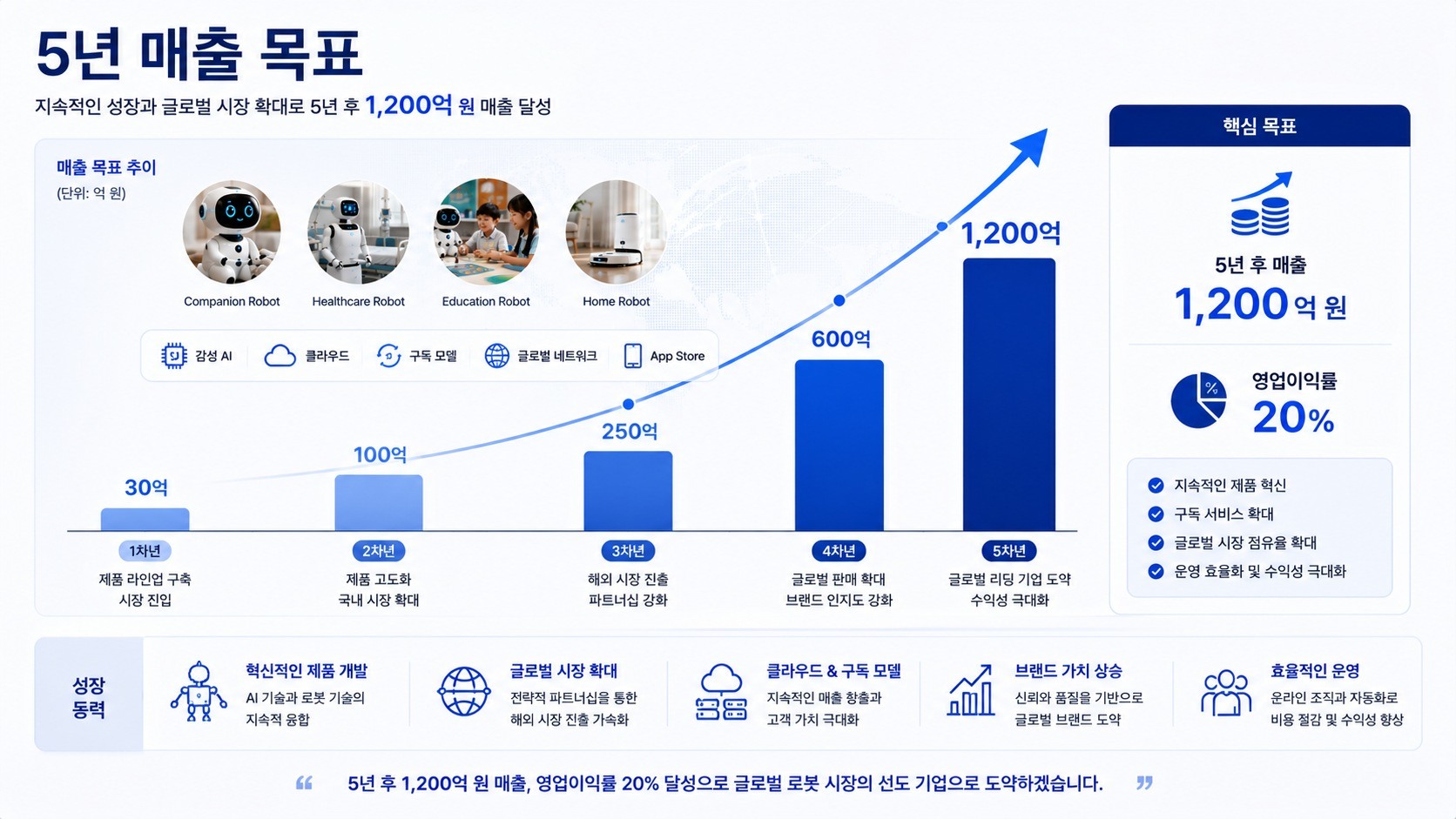
Five-year revenue targets
These are business-plan targets from the company presentation, not actual revenue, orders or guaranteed outcomes. They may change with product launches, production, financing and market demand.
| Period | Revenue target | Planned focus |
|---|---|---|
| Year 1 | KRW 3 billion | Product lineup and market entry |
| Year 2 | KRW 10 billion | Product refinement and domestic expansion |
| Year 3 | KRW 25 billion | Overseas entry and partnerships |
| Year 4 | KRW 60 billion | Global sales and brand development |
| Year 5 | KRW 120 billion | Profitability and market presence |
The presentation also sets a Year 5 operating margin target of 20%. Years are relative planning periods, not calendar years or confirmed launch dates.
View detailed information +
04 / MARKET & TARGETS
Validation & execution
Proposed early pilots observe conversation initiation, repeat use, response satisfaction and operational issues. Willingness to pay and support costs should inform product and service scope.
Expansion depends on dependable production and customer support before broader distribution. Current development status and business plans can be discussed separately in investment and commercial conversations.